 Manta network
 access starts with matching wallet and RPC state
Manta network access depends on a wallet selecting Manta Pacific and an RPC returning the same chain identity and live state. Check chain ID 169, then confirm blocks and balances through that endpoint before signing a transaction. This separates a stale wallet record from a failing connection.
Last updatedChoose the correct Manta environment before connecting
Manta Pacific is the EVM-compatible Ethereum Layer 2 addressed through standard Ethereum wallet and JSON-RPC methods. Manta Atlantic used a Polkadot-style account model and now has a separate migration path. A Pacific endpoint cannot read Atlantic state, even when both names appear within the same ecosystem.
For browser-wallet access, target Manta Pacific with an EVM-capable wallet and a valid 0x account. An Atlantic account won't become a Pacific account by changing its label. Once Pacific is the target, verify the chain ID and RPC response instead of relying on the network label.
Chain ID, RPC, and wallet records
A chain ID distinguishes one EVM chain from another. An RPC endpoint provides the interface for reading blocks, balances, receipts, and contract state. The wallet's network record joins those fields under a readable name.
The display name doesn't prove the connection. Custom network labels are editable, while the chain ID returned by the endpoint reflects the network answering the request. A wallet can therefore say Manta Pacific while its stored endpoint is unavailable, belongs to another chain, or lags behind usable state.
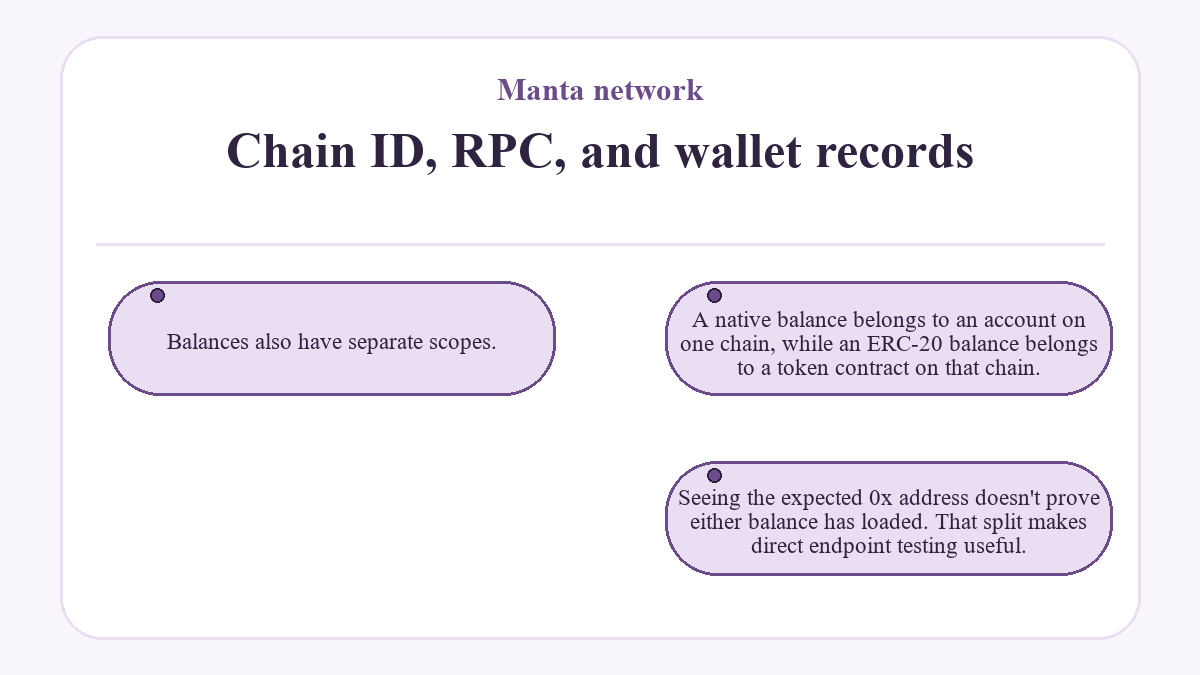
Balances also have separate scopes. A native balance belongs to an account on one chain, while an ERC-20 balance belongs to a token contract on that chain. Seeing the expected 0x address doesn't prove either balance has loaded. That split makes direct endpoint testing useful.
How do you confirm an RPC belongs to Manta Pacific?
Ask the endpoint for its chain identity before relying on any other response.
Manta Pacific mainnet uses
chain ID 169.
The
eth_chainId
method should therefore return
0xa9, the hexadecimal form of 169. Next, inspect
eth_blockNumber
and recent block data to determine whether the endpoint is following the chain rather than serving stale state.
A different chain ID identifies a configuration mismatch, not a wallet-balance problem. A timeout points to transport or provider failure. A matching identity with an old height suggests lag, although a current comparison is needed before calling a height stale. These outcomes lead to different corrections.
A four-stage access check
Suppose the wallet displays Manta Pacific while an application reports an unsupported network. Work from the required environment toward the intended action, and don't request a signature until the prerequisite state agrees.
| Stage | Action | Expected result |
|---|---|---|
| Target | Choose Manta Pacific for EVM access and keep Atlantic migration separate. | The wallet exposes the intended 0x account through an EVM provider. |
| RPC identity |
Read
eth_chainId
from the configured endpoint.
|
The response is
0xa9, equal to decimal 169.
|
| Live state | Read the block height and recent block data. | The endpoint returns valid data and follows newly produced blocks. |
| Wallet preflight | Align the wallet record, then read the account state or simulate the intended call. | The wallet remains on chain 169, and the RPC either returns the requested state or identifies a specific contract error to resolve. |
The normal path ends with an aligned wallet, endpoint, and account view. In the edge case, the endpoint remains reachable but returns another chain ID; replace that network record before repeating the identity and liveness checks. If identity matches but state doesn't advance, keep the chain selection and use another verified endpoint for chain 169. Changing a token contract or bridge route won't repair an RPC transport problem.
Balances, tokens, and contract state
State on Manta Pacific is separate from state at the same address on Ethereum or another EVM chain. Pacific uses ETH as its native gas asset, and
eth_getBalance
reads that native balance. The account needs enough ETH for the gas required by its intended transaction, but the required amount comes from live fee and execution inputs.
An ERC-20 balance comes from the token contract, not from the wallet's native-balance field. The contract address must belong to Manta Pacific.
Use
eth_getCode
to check whether an address has contract bytecode, then query the appropriate contract method for its state. Token decimals affect display formatting rather than the raw stored balance. For a cross-chain transfer, success on the source chain doesn't establish completion on Pacific; the destination receipt, relevant contract events, and destination balance provide separate evidence.
Why can the wallet name be correct while the state is wrong?
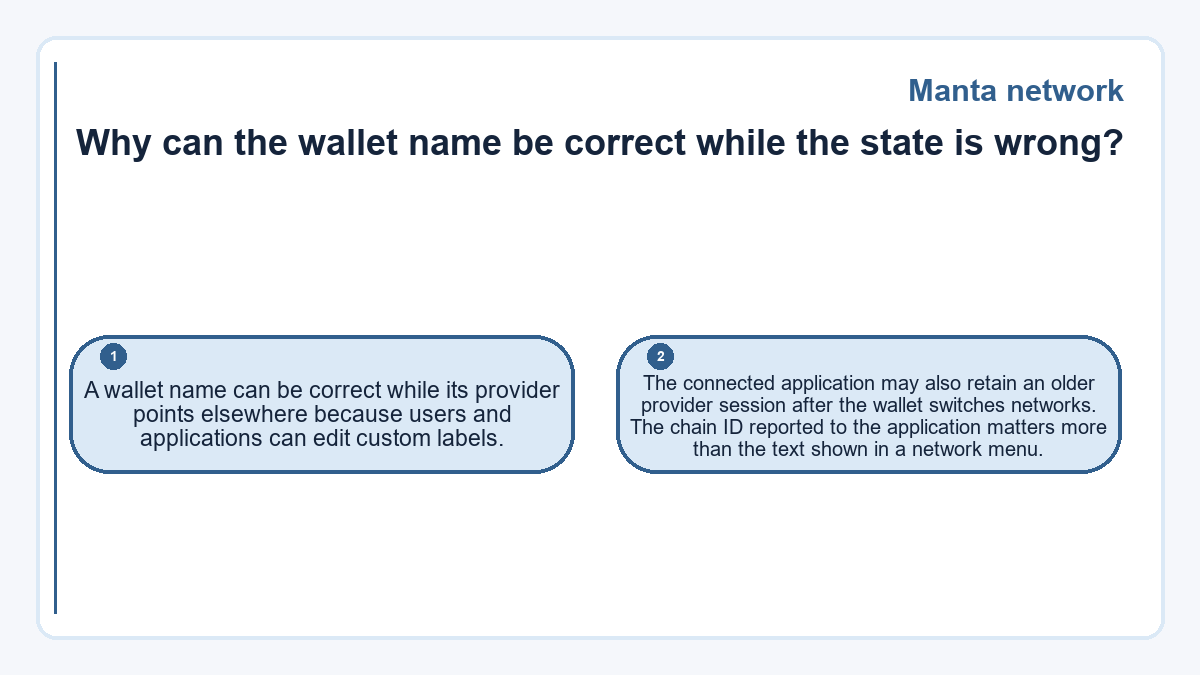
A wallet name can be correct while its provider points elsewhere because users and applications can edit custom labels. The connected application may also retain an older provider session after the wallet switches networks. The chain ID reported to the application matters more than the text shown in a network menu.
The failure pattern narrows the cause. No response indicates an endpoint or transport problem. The wrong identity indicates a network-record mismatch. A matching identity with lagging blocks indicates stale RPC state, while correct blocks with an unexpected balance move the investigation to the selected account, asset type, or contract address. Reconnecting alone won't correct a bad endpoint.
Network architecture and the RPC boundary
Manta Pacific runs as an EVM-compatible Layer 2 in the Ethereum ecosystem, so common Ethereum account formats, transaction calls, and JSON-RPC methods apply. Manta Pacific uses Celestia for data availability. That modular design changes how the network handles data behind the connection, but it doesn't change the wallet's need for the correct chain ID. An RPC connection also isn't a privacy layer: ordinary account balances and transactions remain readable as public chain state, and a remote endpoint can observe the requests sent to it. Adding the network or reading public state through an RPC doesn't require sharing a seed phrase or private key.
Keep connection records usable over time
RPC configuration can age even when the chain ID remains stable. Recheck the endpoint identity and block progress after a provider incident, a wallet reset, or an application that stops recognizing the network. A replacement endpoint is suitable only when it returns chain 169 and follows comparable live state.
Gas estimates are live inputs rather than permanent network constants. The
eth_estimateGas
method simulates a specific call against current state, while fee fields can change with network conditions. A previous estimate shouldn't become a fixed amount in a saved wallet procedure.
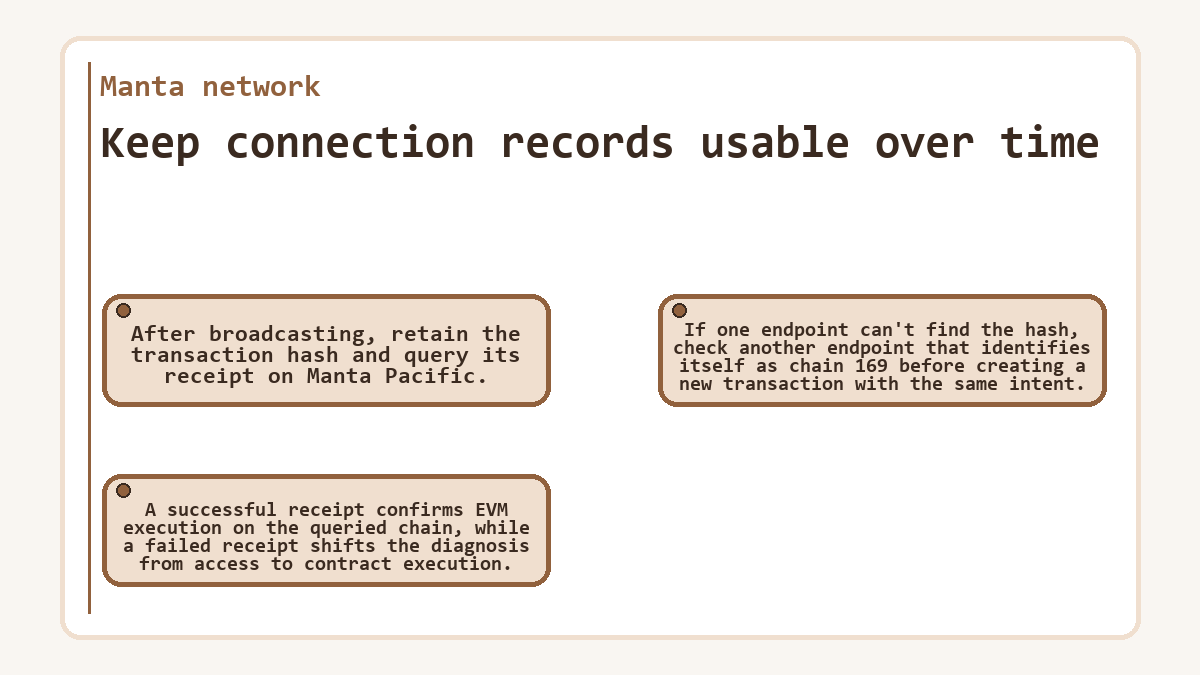
After broadcasting, retain the transaction hash and query its receipt on Manta Pacific. A successful receipt confirms EVM execution on the queried chain, while a failed receipt shifts the diagnosis from access to contract execution. If one endpoint can't find the hash, check another endpoint that identifies itself as chain 169 before creating a new transaction with the same intent.
Manta network: reader questions
Does adding Manta Pacific to a wallet move my assets?
No. Adding Manta Pacific creates or updates a local network record containing the chain identity and RPC connection. It doesn't bridge, transfer, or copy balances from Ethereum, Manta Atlantic, or another chain. Asset movement requires a separate on-chain transaction through a route supporting the source asset and destination network, followed by confirmation of the resulting state on Manta Pacific.
Can the same 0x address exist on Ethereum and Manta Pacific?
Yes. The same private key derives the same 0x account across EVM-compatible chains, so a wallet may display an identical address on Ethereum and Manta Pacific. Each chain maintains its own balances, contract state, nonces, and transaction history. An asset visible at that address on one chain doesn't automatically exist at the corresponding address on the other.
Do I need a special wallet extension for Manta Pacific?
No special Manta-only extension is required for a basic RPC connection. An EVM-capable wallet supporting custom networks can connect when its Manta Pacific record uses chain ID 169 and a compatible RPC. Individual applications may support a narrower set of wallet connection methods, so network compatibility doesn't necessarily mean every application's connection interface will recognize every EVM wallet.
How long should a Manta RPC request take?
Manta Pacific doesn't define one fixed response time for wallet RPC requests. Provider load, network routing, the requested method, and the client's timeout all affect how long a call takes. A quick response from the wrong chain still fails the identity check, while a consistently slow or timing-out endpoint may be unusable even when it eventually returns chain ID 169.
Can a Manta Pacific RPC read a Manta Atlantic account?
No. A Manta Pacific RPC exposes EVM methods and state for chain 169, while Manta Atlantic used a Polkadot-style account and connection model. Entering an Atlantic address into a Pacific wallet record doesn't convert the account or reveal its state. An Atlantic balance or migration issue must use the Atlantic migration path rather than Pacific JSON-RPC calls.
Does a successful RPC call prove a bridge deposit arrived?
No. A successful RPC call only proves the endpoint answered that particular request. Bridge completion requires destination-side evidence, such as the relevant transaction receipt, contract event, or updated balance on Manta Pacific. A source-chain confirmation and a responsive Pacific endpoint can both exist while the cross-chain message or destination transaction remains incomplete.
Why does transaction estimation fail after the chain ID matches?
A matching chain ID resolves network identity, but it doesn't guarantee the intended contract call can execute. Estimation may fail because the account lacks enough ETH for gas, the destination has no contract code, the calldata is invalid, a required approval is missing, or the contract rejects the current state. The returned simulation error should guide the next check instead of an arbitrary gas increase.