 Manta network
 suits EVM applications when Manta Pacific's dependencies match the job
Manta network gives EVM applications an execution environment through Manta Pacific, its Ethereum Layer 2. It fits best when the app, wallet, gas asset, bridge route, and off-chain services all support that chain. Frequent contract calls and familiar Solidity tooling can make the network attractive. Missing liquidity, unavailable oracle coverage, or an unacceptable exit delay can still disqualify it. Choose the complete operating path, not one metric in isolation.
Last updatedChoose Manta Pacific when the EVM app, its chain-specific services, ETH gas, and exit route all support the intended job.
EVM goals that fit Manta Pacific
The clearest use is an application whose work already maps to EVM transactions and benefits from repeated on-chain execution. Manta Pacific is EVM compatible, so standard Solidity contracts can run without a chain-specific programming language. Existing Ethereum libraries, wallet connections, and JSON-RPC methods can therefore remain useful.
- A user makes repeated calls to an application already deployed on Manta Pacific.
- A developer ports a Solidity contract whose libraries and external services support the chain.
- An application verifies zero-knowledge proofs through contracts designed for that purpose.
- A team needs Ethereum-style wallet and JSON-RPC behavior outside Ethereum mainnet.
Each goal depends on different evidence. User fit appears in executable routes, available assets, and acceptable transaction costs. Developer fit includes deployment controls, chain-specific contract addresses, and service coverage. A proof-enabled feature also needs a defined disclosure model because the network's identity doesn't determine what an application hides.
Manta Pacific, Ethereum, and another EVM L2 by job
The execution location should follow the state and services the application actually needs. These choices share EVM concepts, yet they don't share contracts, balances, liquidity, or finality paths.
| Execution choice | Best-matched job | Required conditions |
|---|---|---|
| Manta Pacific | Repeated EVM application calls or a Solidity deployment using Pacific-based contracts | The required app, assets, services, ETH gas, and exit route support Manta Pacific |
| Ethereum mainnet | Direct interaction with Ethereum contracts, assets, and composable L1 state | The job can absorb Ethereum execution costs and confirmation conditions |
| Another EVM Layer 2 | An application whose essential liquidity, oracle, bridge, or deployed contract exists there | That chain has the required app, its supporting services, and the desired exit path |
| Select the chain where the full application path exists; contract compatibility alone doesn't supply assets, services, or an acceptable exit. | ||
Manta Pacific is most convincing when the operator controls the deployment or the required application already runs there. Ethereum better serves work requiring direct L1 composition. Another EVM Layer 2 becomes preferable when a missing Pacific dependency would otherwise add a bridge, custom data service, or operational workaround.
Porting contracts without importing hidden assumptions
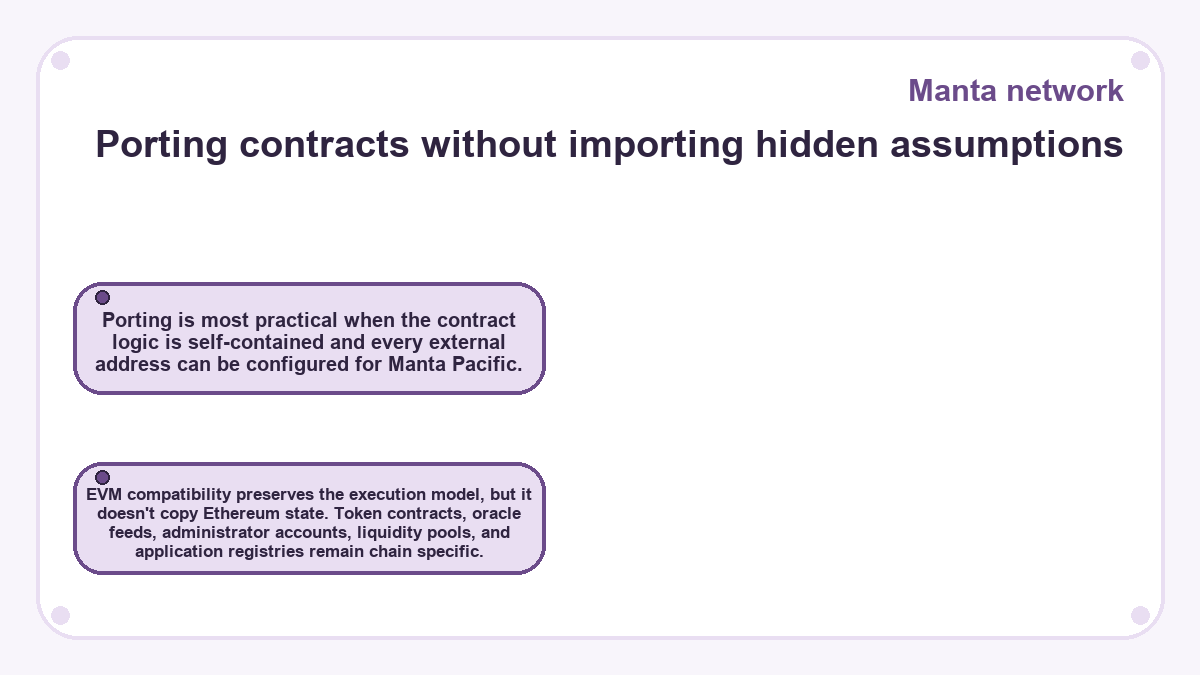
Porting is most practical when the contract logic is self-contained and every external address can be configured for Manta Pacific. EVM compatibility preserves the execution model, but it doesn't copy Ethereum state. Token contracts, oracle feeds, administrator accounts, liquidity pools, and application registries remain chain specific.
Review every address the deployment reads or calls. Constructor arguments, role assignments, proxy administrators, relayers, keepers, and indexers may all need Pacific-specific configuration. Cross-chain messages also have asynchronous delivery and different sender semantics from ordinary same-chain calls. A contract can compile and deploy correctly while the overall application remains unusable because one service points to Ethereum or doesn't support Pacific.
Wallet, gas, and asset prerequisites
Manta Pacific mainnet uses chain ID 169 and ETH as its gas currency.
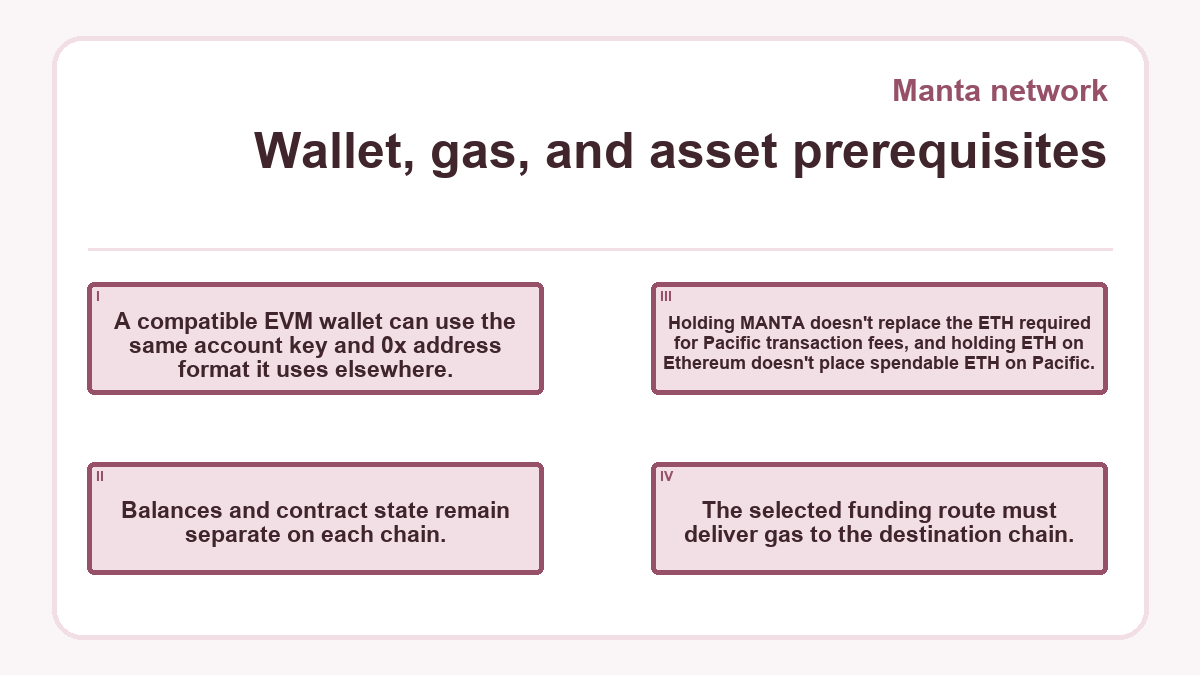
A compatible EVM wallet can use the same account key and 0x address format it uses elsewhere. Balances and contract state remain separate on each chain. Holding MANTA doesn't replace the ETH required for Pacific transaction fees, and holding ETH on Ethereum doesn't place spendable ETH on Pacific. The selected funding route must deliver gas to the destination chain.
Asset identity needs the same precision. A bridged ERC-20 token normally has its own Manta Pacific contract address, even when its symbol matches the Ethereum asset. Applications should bind balances, approvals, and contract calls to the destination address supplied by the selected bridge mapping. This prevents a familiar ticker from masking the wrong contract.
Bridges and exits set the time horizon
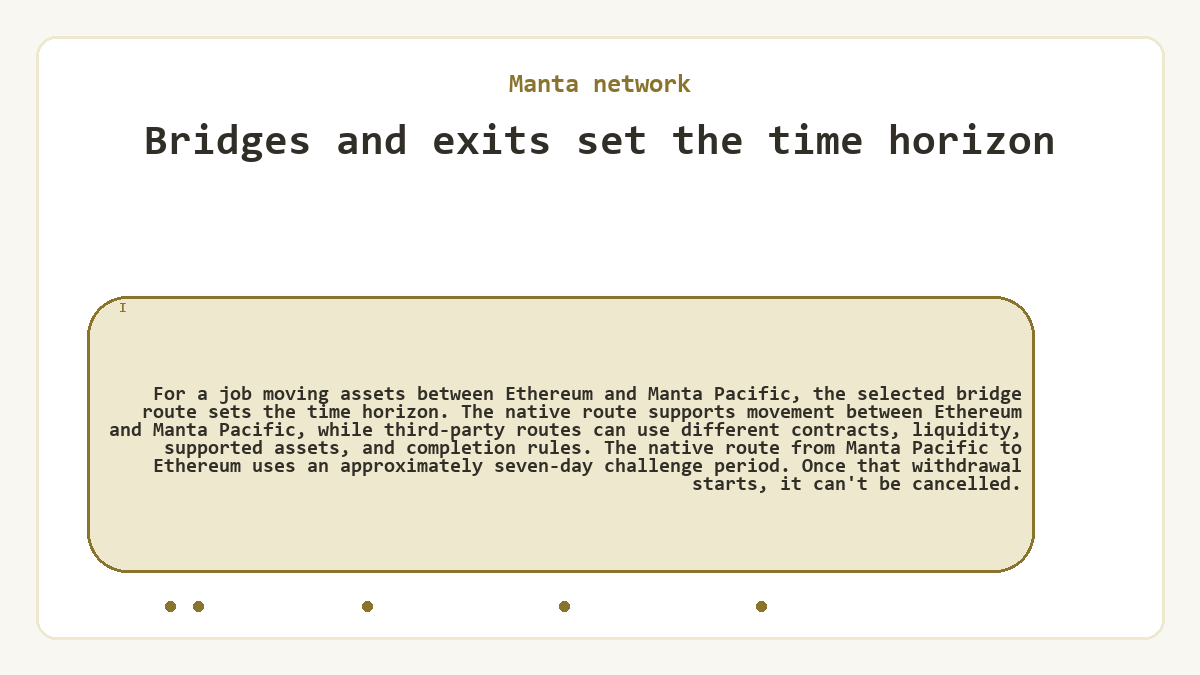
For a job moving assets between Ethereum and Manta Pacific, the selected bridge route sets the time horizon. The native route supports movement between Ethereum and Manta Pacific, while third-party routes can use different contracts, liquidity, supported assets, and completion rules. The native route from Manta Pacific to Ethereum uses an approximately seven-day challenge period. Once that withdrawal starts, it can't be cancelled.
A short interaction can still create a long exit commitment if the asset must return through the native route. A liquidity-based bridge may complete sooner, but its quote, capacity, and failure process belong to that provider. If the job requires immediate reversibility or one synchronous transaction across chains, Manta Pacific isn't a suitable execution location. Keeping the work where its assets and final state already reside removes that bridge boundary.
What makes a Manta Pacific outcome verifiable?
A usable outcome is a confirmed receipt plus the application state the job was meant to change. A successful transaction shows the contract accepted and executed the call. It doesn't establish that a balance, role, record, proof, or downstream message reached the intended value.
That distinction matters most when an app depends on a relayer or indexer.
Read the destination contract's state and inspect the relevant event or balance after execution. A stale interface can coexist with a successful on-chain write because its indexer hasn't caught up. The reverse is also possible: a wallet can display a valid transaction sent to the wrong chain or contract. Define completion through a specific Pacific state, then include any off-chain output the application needs.
ZK features and public chain activity
ZK capability applies where an application integrates a proof system and defines which facts remain undisclosed. Ordinary EVM transactions still expose public chain data such as addresses, contract calls, values, and emitted events. Deploying an unchanged public contract on Manta Pacific doesn't create private balances or private transfers.
Manta Pacific uses Celestia for data availability within its modular architecture. That layer helps make transaction data available for chain operation; it doesn't provide application-level confidentiality. When privacy decides the fit, inspect the application's circuit, public inputs, event design, and key handling. A different design or purpose-built privacy mechanism is preferable when those disclosures exceed the job's requirements.
Maintenance boundaries for a durable fit
An initially suitable deployment remains suitable only while its dependencies continue serving the same chain and asset identities. Track application contracts, RPC availability, bridge support, token mappings, oracle freshness, relayer status, and indexer lag. Configuration changes should be tested against the state transition users rely on, not merely against a successful wallet connection.
Fees, liquidity, and bridge capacity are live variables. Read them when the action is prepared rather than storing them as permanent assumptions.
Manta Pacific is the better choice when the EVM workload, chain-specific services, user funding path, exit timing, and observable completion state all align. Use Ethereum when direct L1 composition is essential. Prefer another EVM network when the required application or service only operates there. Revisit the decision when a dependency or the intended job changes.
Manta network: common questions
Does Celestia data availability let an EVM contract read Celestia directly?
No. Celestia supplies data availability for Manta Pacific's rollup architecture; it isn't a general data feed exposed automatically to EVM contracts. A contract needing outside data still requires a supported oracle, messaging path, or application service. Treat Celestia's role as infrastructure beneath the chain, not as an application-level API.
Are Ethereum oracle feeds automatically available on Manta Pacific?
No, Ethereum oracle deployments don't appear on Manta Pacific automatically. Confirm the provider supports the chain, use its Pacific contract address, and test update freshness under the application's failure rules. If the required feed isn't deployed or maintained there, another network or a redesigned data path is the cleaner choice.